A search volume of 1,000 does not mean 1,000 people will visit your page. It means Google's systems estimate roughly 1,000 searches per month, averaged across a year, rounded into a bucket.
Every confusing thing about volume follows from that sentence. Unpack it and the number becomes genuinely useful.
What the number is actually made of
Searches, not searchers. Repeat searches count every time. Navigational and habitual queries inflate this way, commercial research queries less so.
An average, not a rhythm. "1,000 a month" might be 12,000 spread evenly, or 10,000 in December and dribbles all year. The average hides which.
The seasonality trap
Before committing to a keyword, glance at its shape in Google Trends or at the 12-month trend column tools show next to volume. A spike keyword needs publishing months before the spike.
Why every tool disagrees
All volume data descends from Google's advertising systems, then each tool blends in clickstream panels and its own modeling. Different blends, different rounding, different numbers.
The practical rule: compare keywords within one tool, never across tools. Inside one dataset the relative sizes hold, and relative size is the actual decision input.
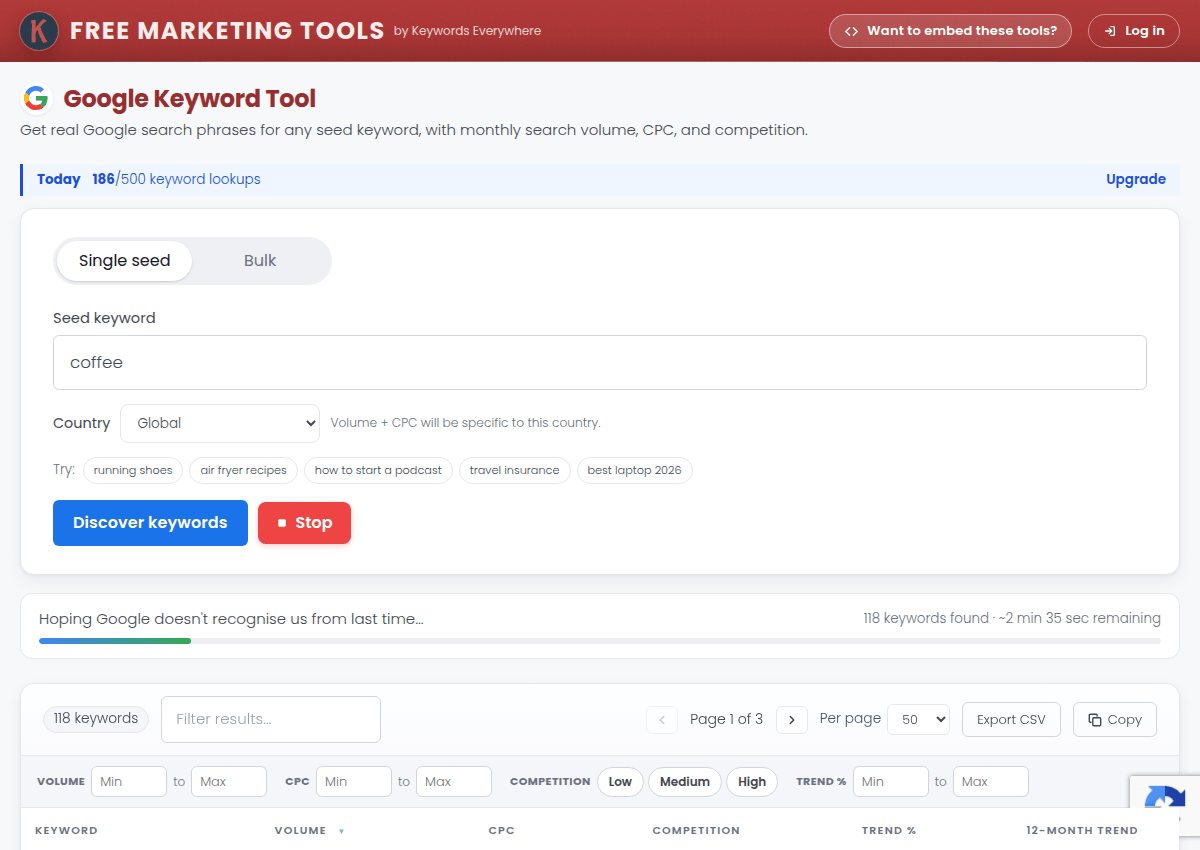
For a free source of exact figures, the Keywords Everywhere Google Keyword Tool shows monthly volume with CPC and competition per keyword, 500 lookups a day without an account.
Volume to clicks: the honest math
| If volume is | And you rank | Realistic monthly clicks |
|---|---|---|
| 1,000 | #1 | Roughly 250 to 350 |
| 1,000 | #3 | Roughly 80 to 120 |
| 1,000 | #8 | Roughly 20 to 40 |
| 1,000 | #15 | A trickle |
Those ranges shrink further when ads, featured snippets or AI answers sit above you. Volume is the ceiling's ceiling, not a forecast.
How to actually use volume
- Sort, do not worship. Volume ranks opportunities within your list. It cannot bless a keyword whose intent is wrong for you.
- Respect small numbers with sharp intent. "Cold brew maker with spout" at 90 searches converts better than "coffee" ever will.
- Check the shape. Average plus trend beats average alone, every time.
- Let your own data trump estimates. Once you rank, Search Console impressions are the real volume for you.
Our 7-step keyword research process shows where volume fits among intent and difficulty, and the free tools roundup covers where to get the numbers.
The one-line takeaway: search volume is a rounded, year-averaged estimate of searches, not a promise of visitors. Use it to compare keywords inside one tool, check the seasonal shape, and let intent make the final call.