Keyword research sounds like a discipline. It is really seven small steps, and this guide walks all seven with free tools only.
Collect the words your customers use, expand them into every phrasing people type, and put numbers on the list. Then sort by what searchers want, check who you are up against, pick fights you can win, and give each winner a page.
Our running example: imagine you sell cold brew coffee gear online. Small site, no famous brand, no budget.
| Step | What you do | Free tool | What you end up with |
|---|---|---|---|
| 1 | Collect seed keywords | Your head, your customers, competitors | About 10 seeds |
| 2 | Expand into long-tails | Autocomplete tools | Hundreds of real phrases |
| 3 | Add the numbers | Keyword Planner, KE Google Keyword Tool | Volume, CPC per keyword |
| 4 | Sort by intent | Your judgment (10 minutes) | Keywords grouped by goal |
| 5 | Check difficulty | Ahrefs difficulty checker + eyeballing page 1 | Honest odds per keyword |
| 6 | Pick winnable targets | Sorting from steps 3 to 5 | 20 to 30 keywords |
| 7 | Map keywords to pages | A spreadsheet | Your content plan |
Step 1: Collect about 10 seed keywords
Seeds are the two-or-three-word phrases your whole niche hangs off. For the cold brew shop: cold brew coffee, cold brew maker, cold brew ratio, coffee grinder, iced coffee.
Three places to find them:
- Customer language. Emails, reviews and support questions, in the exact words people use. Nobody searches "immersion brewing vessel", they search "cold brew jar".
- Competitor menus. Open three competitor sites and read their navigation. Every menu item is a seed they considered worth a page.
- One AI brainstorm. Ask ChatGPT for subtopics of your niche, and take the topics but ignore any numbers it offers.
Stop at roughly 10. More seeds now just means duplicates later.
Step 2: Expand each seed into hundreds of real phrases
Google Autocomplete is the most honest keyword source there is. It only suggests things people actually type.
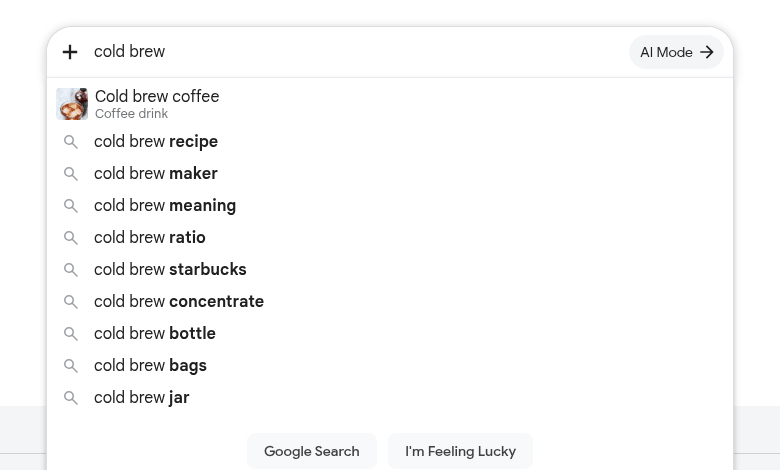
Typing "cold brew " and cycling a to z by hand works, but takes an afternoon. Autocomplete tools automate exactly that.
The keyword tool on this site takes your seeds and streams back up to 10,000 real suggestions per run, free. Question tools like AnswerThePublic cover the who-what-why phrasings on top.
From our five cold brew seeds, expansion typically lands 400 to 800 unique phrases. Things like "cold brew ratio grams", "cold brew maker with spout", "can you heat cold brew".
Export everything. Messy is fine, the next steps do the cleaning.
Step 3: Put numbers on the list
Paste the list into Google Keyword Planner (free with a Google Ads account) or the free Google Keyword Tool from Keywords Everywhere, which shows monthly volume, CPC and competition without an account. You now care about two columns.
- Volume tells you the size of the prize. Do not worship it: about 95% of all keywords get 10 or fewer searches a month according to Ahrefs' index research, and those long-tails are exactly where small sites win.
- CPC tells you what advertisers pay for a click. A $6 CPC on "best cold brew maker" is advertisers voting with money that those searchers buy things.
Step 4: Sort by what the searcher actually wants
Two keywords with identical volume can deserve completely different pages. The person behind each wants a different thing.
The classic four buckets:
Sorting 400 keywords into these buckets sounds slow. It is 10 minutes, because the words give the intent away ("how", "best", "buy", brand names).
Skip navigational keywords for other brands entirely.
Step 5: Check difficulty honestly
Ahrefs' free Keyword Difficulty Checker scores any keyword from the backlink strength of the current top 10. It mirrors what you should also do by hand at least once: search your keyword and look at page 1.
The eyeball rules:
- All big brands and major publications? Move on, for now.
- A forum thread, a thin page or a site your size in the top 5? Real opening.
- The results do not quite match what the query wants? Best opening of all, because Google is settling, and settling means beatable.
Step 6: Pick 20 to 30 winnable keywords
Now shrink the list with three filters. Right intent for a page you can genuinely build, difficulty you can survive, and volume above zero but below vanity.
For the cold brew site the picks land things like "cold brew ratio calculator" (weak page 1), "best cold brew maker under 50" (the qualifier keeps giants away), and "how long does cold brew last" (evergreen question with a snippet to win).
Watch how the funnel narrows:
Step 7: Map every keyword to a page
The last step is a spreadsheet with four columns: keyword, intent, page that will target it, status. One main keyword per page, and close variants ride along free.
"Cold brew ratio", "cold brew coffee ratio" and "cold brew ratio grams" are one guide, not three. "Cold brew vs iced coffee" is its own comparison page.
Write the easiest wins first. Early rankings teach you what Google thinks of your site while the harder pieces are still in progress.
Then leave the plan alone and go build. A quarterly refresh beats re-researching every month.
If you have not chosen your toolkit yet, our ranked list of the 12 best free keyword research tools covers which tool fits each step above.
The mistakes that waste the most time
- Chasing one big keyword. "Coffee" is not a strategy. Twenty long-tails you can win beat one head term you cannot.
- Skipping intent. A product page will not rank for a "how to" query, no matter how good the product is.
- Trusting AI numbers. Brainstorm with ChatGPT freely, but verify every volume in a real tool.
- Researching forever. Two hours of research and four hours of writing beats six hours of research every single time.
The one-line takeaway: collect real language, expand it with autocomplete, and keep only what has numbers, the right intent and beatable competition. Then give every survivor its own page.