Google Autocomplete is the only place Google shows you its query logs directly: every suggestion is generated from searches people actually ran. It cannot imagine keywords, which is precisely its value.
This site's whole tool exists because of that property. Here is how the system works, and every mining pattern worth knowing.
What feeds a suggestion
The policy filters matter for research: Google suppresses some categories entirely, so autocomplete under-reports certain niches rather than lying about them.
The mining patterns
Manual mining is typing a seed plus one more character and harvesting what appears. The patterns multiply coverage:
| Pattern | You type | It surfaces |
|---|---|---|
| A to Z suffix | "cold brew a", "cold brew b" ... | The alphabetical tail |
| Question words | "can cold brew", "why cold brew" | Question keywords |
| Prepositions | "cold brew for", "cold brew without" | Audiences and constraints |
| Comparisons | "cold brew vs", "cold brew or" | Versus keywords |
| Mid-phrase gap | "best _ cold brew maker" (cursor mid-phrase) | Completions inside phrases |
| Prefix flip | "a cold brew", "b cold brew" ... | Modifiers before the seed |
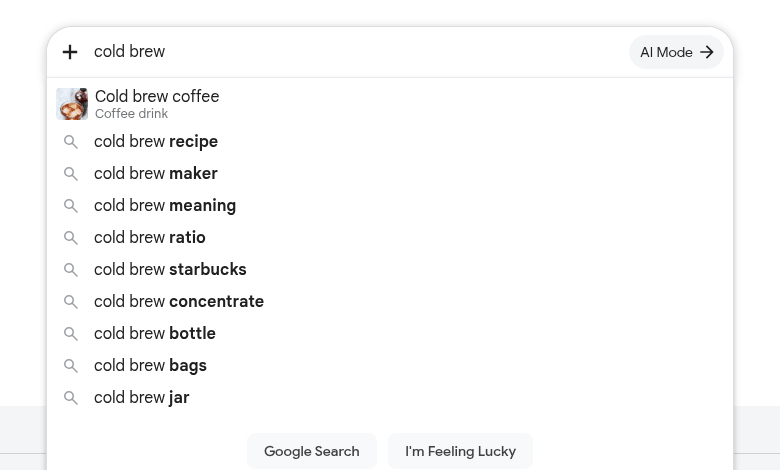
Automating the harvest
Every pattern above is what the keyword tool on this site automates: it cycles the suffixes, prefixes and question words across your seeds and streams every suggestion Google returns, up to 10,000 per run, free.
Two habits make the harvest cleaner. Mine in a neutral context (the tool does this for you, your browser does not). And keep the weird finds: "cold brew salt" looks odd until you learn people genuinely ask about it.
Autocomplete's blind spots
No numbers. Existence and rough ranking, yes; volumes, no. Size the harvest afterwards with the free volume stack.
Popularity bias. Brand-new phrasings take time to appear, so pair autocomplete with community sources for the bleeding edge.
Policy gaps. Suppressed categories mine thin. Absence of suggestions is not always absence of demand.
From dropdown to keyword plan
Autocomplete owns step one of research: the raw list of real phrasings. Intent sorting, volumes and difficulty then shrink it to targets, the full pipeline our 7-step process walks.
The tail it surfaces is exactly the tail worth owning, and the long-tail guide covers why those small phrases compound.
The one-line takeaway: autocomplete is Google quoting its own users back to you. Mine it with suffixes, prefixes, questions and gaps, automate the cycling, then size the harvest with real volume data.