Search volume tells you how many people search. CPC tells you what a visitor is worth, priced by people spending real money to acquire them.
Read together, the two columns find the keywords where ranking pays. Read wrong, one of them quietly lies to you, and it is the competition column.
CPC: advertisers voting with money
Cost per click exists because advertisers bid in an auction for each keyword. A $9 CPC on "cold brew maker commercial" means businesses have tested that a click converts well enough to justify $9.
That makes CPC the cheapest market research in your toolkit: someone else already paid to learn which searches produce buyers.
| CPC reads | Usually means | Organic play |
|---|---|---|
| $0.00 to $0.30 | Informational or thin commercial intent | Traffic and audience plays |
| $0.30 to $2 | Mild commercial pull | Content that feeds product pages |
| $2 to $10 | Proven buyer traffic | Priority targets if difficulty allows |
| $10+ | High-value conversions (B2B, finance, legal) | Worth long campaigns, expect a fight |
The bands are directional, not laws: niches differ, and a $1 click in a high-margin niche can outearn a $6 click elsewhere.
The competition column trap
The practical consequence: "low competition" in a keyword tool does not mean easy to rank. It means few advertisers bid, which sometimes even signals a keyword advertisers know converts poorly.
Judge ranking odds with a real difficulty check instead, the way our difficulty guide lays out.
The combinations that matter
- High CPC + weak organic page 1: the pocket. Advertisers proved the value, organic incumbents left the door open.
- High CPC + fortress page 1: valuable, later. Feed it from long-tail variants first.
- Low CPC + strong volume: audience builders. Monetize indirectly.
- High ad competition + low CPC: crowded penny traffic, usually skip.
Where to see all three columns free
The free Google Keyword Tool from Keywords Everywhere streams volume, CPC and competition side by side for any seed, 500 lookups a day, no account.
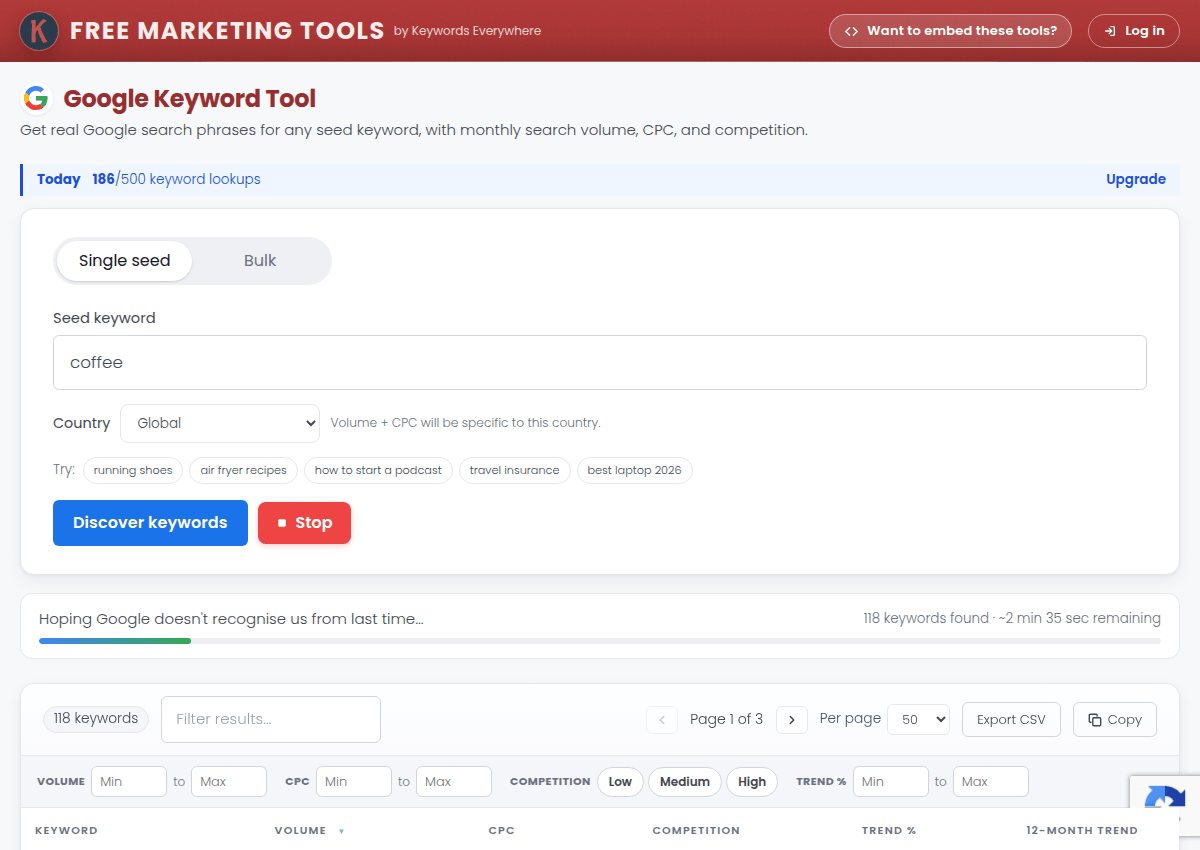
Google Keyword Planner shows the same advertiser view with bid ranges, useful when you want the auction's own numbers.
A worked example
From a cold brew seed list: "cold brew ratio" reads $0.20 CPC, big volume: an audience keyword, and our guide for it feeds everything else.
"Best cold brew maker" reads $1.80 with heavy ad competition and a beatable organic page 1: priority target. "Commercial cold brew brewer" reads $7.40, modest volume, weak organic results: the pocket, and the page that pays the hosting bill.
The one-line takeaway: CPC is proof of value paid for by someone else, and the competition column only describes the ad auction. Pair high CPC with a weak organic page 1, verified separately, and you have found the keywords worth money.